
Week 6
Updated: 2026-10-17
The final week of the course — listen to it when you are already back together, so as not to repeat old mistakes.
Sometimes it turns out that the guy cared about the 'sporting challenge' rather than the relationship itself — then it is worth honestly acknowledging this and carefully ending the relationship.
Keep variety in physical intimacy: more often give her what she simply loves, occasionally — what delights her, and don't let it become routine.
Communication should be healthy, measured, and mindful: when you are with her — be truly with her, without autopilot and half-listening.
Don't lose your leading position: a woman comfortably follows a leader, but leadership is not shouting and tyranny — it is calmness, humor, and confidence.
A woman leaves when she has 'outgrown' the man: make her feel that you are leading her by the hand and continuing to grow together with her.
If the result has not been achieved: check the quality of following the instructions, be patient (a normal timeframe is 2–3 weeks to 2–3 months); if fully blocked — pause for 1–1.5 months and repeat the steps from week one.
You cannot move too slowly — there are only actions that are too fast; do everything gradually.
Where this week usually goes wrong
Week 6 fails on one pattern: the finish line. The man got what he wanted — and over a month, slowly and invisibly, slides back into the behavior that destroyed everything: dissolving into her, cancelling his own life, starting to "earn" her goodwill again.
The second failure: a campaign instead of a lifestyle. The first month back together is flawless — gym, humor, calm, initiative. By month two it turns out it was all stage set: the gym membership untouched, guy nights replaced by her shows, lightness replaced by scorekeeping and grievances.
The third: repetition. He replays the winning moves on a loop: same jokes, same weekends, same initiatives. Routine returns not from time but from sameness; variety isn't about "keeping her interested" — it's about the fact that a living life is never the same route twice.
And the fourth, which the course says out loud: sometimes it turns out what he really wanted was the comeback itself — the win, not the woman. If a couple of months in you feel not closeness but relief that you "pulled it off," the honest move is to admit it and end things carefully, not to keep playing the role.
- Your life's anchors (training, friends, work, your own interests) don't get cancelled after "we're together again."
- Check yourself monthly: is the Week 1–5 behavior still you — or a retention performance?
- Variety: at least one new shared activity a month, and your own separately lived plans.
- Honesty about your motive: do you need her — or did you need to "get her back"?
The three zones where old mistakes return
Zone one: intimacy. It can't be a schedule, and it can't be proof-of-relationship ("I guess things are fine between us"). Living intimacy runs on interest in the person, not on a calendar. If it turns into routine, the fix is the same kind of talk as the Week-5 status talk: short, ordinary, no blame.
Zone two: daily life and communication. Old fights come back through old phrases: "you always," "and that time you…" A proven rule: speak about the specific action, here and now, not about the person's character in general. "It stung that you didn't call back yesterday" is a conversation. "You never call" is a verdict — after which no conversation is needed.
Zone three: leadership. Not "being the boss," but initiative: plans, places, talks, decisions. A man who won her back and then lay down on the couch ("she's not going anywhere") reproduces the exact picture she once walked out of. Leadership is work you don't do until the comeback — you do it the whole time.
Honestly, again: all three zones are skills for years, not a checklist for a week. Week 6 is the point where the course ends and practice without a manual begins.
What not-repeating-old-mistakes sounds like
The old fight: she forgot something you'd agreed on; you're boiling. Old road: "This is exactly why I buried myself in work last time." New road: "I'm annoyed, so I'm keeping this short — I don't want to say things I'll regret. Let's come back to it tonight." The pause instead of escalation is the hardest and most working move there is.
The old fear: things are good, but you're gnawed by the suspicion that her interest is fading. Old road: checking her phone, indirect interrogations, "do you even love me?" New road: name the feeling: "I had a lousy day and the old fears crept in. Tell me something good about us." Asking for support is not the same as demanding a report.
The old routine: third month of identical weekends. Old road: stew in silence. New road: "Saturday — no plan. I'll pack a bag, you get yourself ready, we drive wherever the road goes." Concrete, light initiative, zero accusation of boredom.
And the hard one: you catch yourself feeling that being with her is duller than the chase was. Old road: drag it out and drift into an affair. New road: "I need to talk to you honestly — not about logistics, about us." A breakup conversation is also a conversation, and this course teaches you not to hide it.
Week 6 checklist (and every month after)
- Your anchors are standing: training / friends / your own project exist the way they did in Week 2.
- No fight slid into "you always" or dragged up the past.
- This month contained at least one new shared thing you'd never done before.
- This month contained an evening spent apart — without guilt on either side.
- You can honestly answer why you're in this relationship — and the answer doesn't contain the word "won."
- If items fail two months running — that's not panic material, it's a conversation from the section above.
A short vignette: a year later
A composite example. A year after the comeback, R. caught himself on the fact that Saturday had run on the old script again — and it didn't anger him, just made him sad. He remembered the variety rule, but what worked wasn't the rule; it was one honest question asked out loud: "What's something you've been wanting to do that we haven't done in forever?"
Turned out she'd wanted a September beach trip for six months and said nothing, afraid he'd say he couldn't get away. He could. They went. Funnily enough, that one conversation started a tradition — a monthly "what do you actually want?" check-in — which has kept things livelier than any relationship technique.
In another composite case, a man honestly admitted three months in that pride had been holding him, not love. They broke up a second time — calmly, without venom — and that second, honest ending was exactly what let both of them move on. This course doesn't promise that winning her back is always the right answer. It promises you'll be able to take any answer honestly.
After the final week
There's no subscription and no "next level" after this. Everything from Weeks 1–5 — calm instead of pleading, your own life instead of waiting, lightness instead of pressure, honest talks instead of bargaining — stops being a method in Week 6 and becomes simply how you live.
If the comeback didn't happen, the material works for that outcome too: a man who walked these weeks honestly finishes the path not empty, but with a rebuilt life that needs nothing given back to it.
If it did happen, keep the final week's main formula: the behavior that brought the relationship back is the very reason it's worth keeping. Remove it, and you both end up right back where you started. Keep it, and you'll have something the two of you never had before.
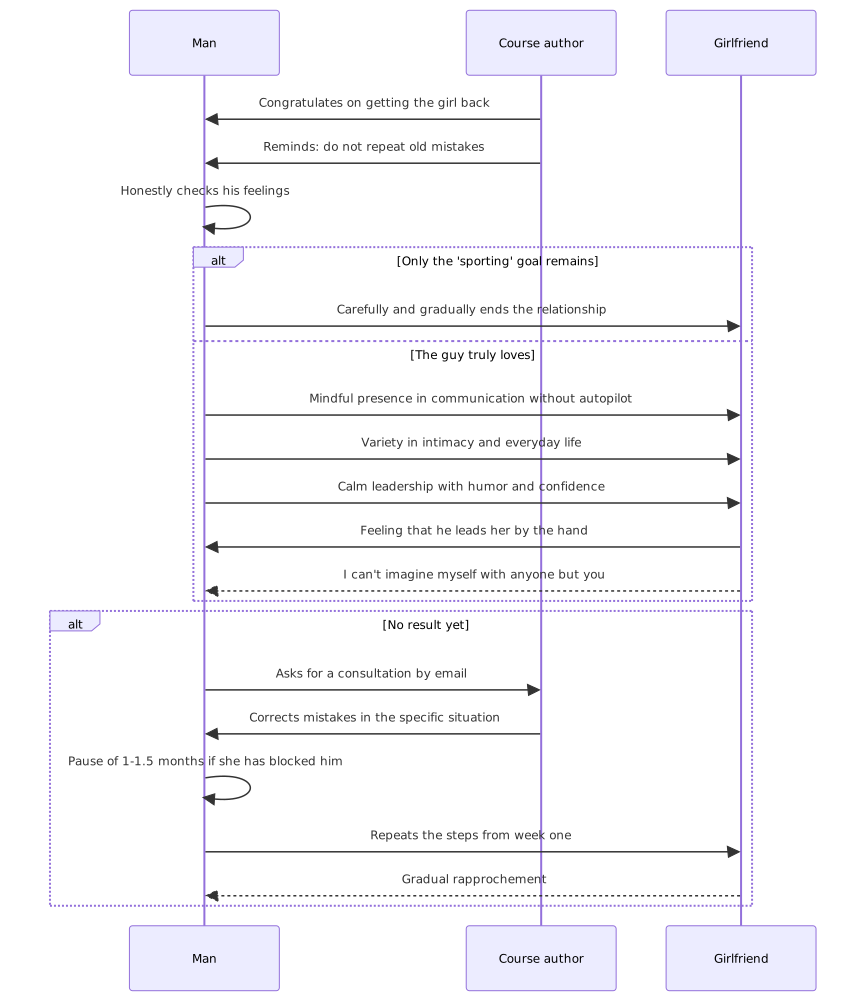
Diagram: who does what — текстовая версия
- L → M: Congratulates on getting the girl back
- L → M: Reminds: do not repeat old mistakes
- M: Honestly checks his feelings
- M → W: Carefully and gradually ends the relationship
- M → W: Mindful presence in communication without autopilot
- M → W: Variety in intimacy and everyday life
- M → W: Calm leadership with humor and confidence
- W → M: Feeling that he leads her by the hand
- W → M: I can't imagine myself with anyone but you
- M → L: Asks for a consultation by email
- L → M: Corrects mistakes in the specific situation
- M: Pause of 1-1.5 months if she has blocked him
- M → W: Repeats the steps from week one
- W → M: Gradual rapprochement

Diagram: order of steps — текстовая версия
- A1[The girl came back] → A2{Honest question: do I really need her?}
- A2 → (The sporting challenge has passed) A3[Carefully end the relationship without hurting her]
- A2 → (Yes I love her) A4[Develop intimacy and variety]
- A4 → A5[Give her what she loves every day]
- A5 → A6[Sometimes delight her]
- A6 → A7[Mindful communication without autopilot]
- A7 → A8[Be truly with her when you are together]
- A8 → A9[Hold the leading position]
- A9 → A10[Calmness humor confidence without shouting]
- A10 → A11[Lead her by the hand and develop yourself]
- A11 → A12[She feels: this is the man]
- A12 → A13[Long happy relationship]
- A9 → A14{Is she completely out of contact?}
- A14 → (Yes) A15[Pause of 1-1.5 months]
- A15 → A16[Repeat the steps of weeks 1-6 slowly]
- A14 → (No but stuck at a stage) A17[Stay at the current stage longer]
- A17 → A18[Find the mistake or write to the course author]
- A18 → A9